Offers
 Account
 Menu
Menu Favorite
 Basket



 Need Optical Advice?












 Updated on:
31 July, 2026
Updated on:
31 July, 2026



 Copy Link



Experiencing vision problems is common among people with multiple sclerosis (MS). In this neurodegenerative condition, the immune system of the body mistakenly attacks the protein (myelin) that surrounds and protects nerves. It affects the spinal cord, brain and optic nerves (the nerves that send visual information to the brain). As this interconnected system helps to see and control the eye’s functions, any issue that occurs in the nervous system due to MS can cause a range of vision issues.
Read on to know how MS affects the eye’s functions, including symptoms, vision changes and available treatment options.
- Common MS eye symptoms
- Multiple sclerosis vision problems
- Multiple sclerosis diagnosis
- Treatment options for MS eye symptoms
- Frequently asked questions
Common MS eye symptoms
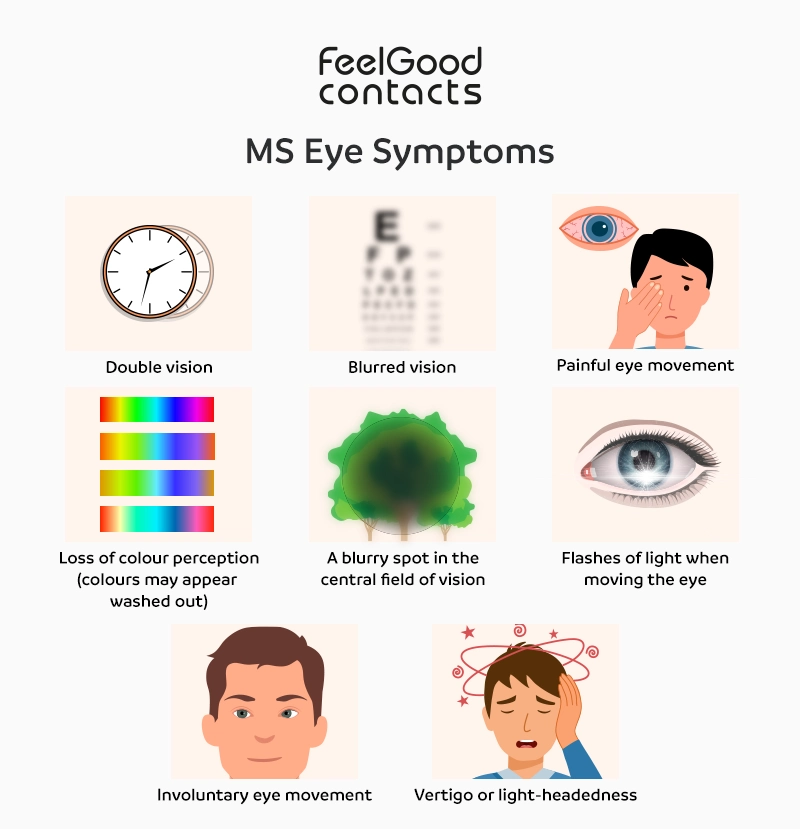
The most common symptoms include:
- Double vision (diplopia)
- Blurred vision
- Painful eye movement
- Loss of colour perception (colours may appear washed out)
- A blurry spot in the central field of vision
- Flashes of light when moving the eye
- Involuntary eye movement
- Vertigo or light-headedness
Multiple sclerosis and vision disorders
The most common vision problems associated with multiple sclerosis are listed below:
Optic neuritis
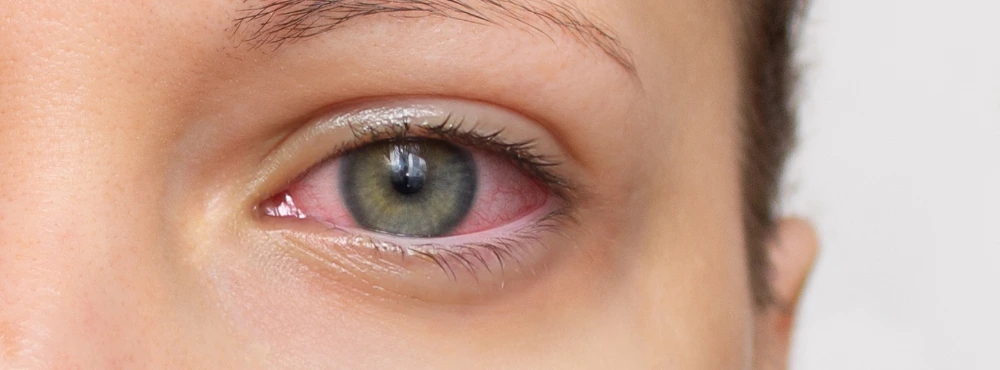
This condition occurs when the optic nerve, which carries the information to the brain, has inflammation. When the optic nerve is swollen, the signal between the eye and the brain is disrupted, causing blind spots and colour vision defects in the affected eye. It is often considered an early sign of MS; however, it can develop later in the course of multiple sclerosis. Not everyone with optic neuritis will develop multiple sclerosis, though.
Double vision (Diplopia)
It happens when the nerve system controlling your eye’s movement is damaged. An imbalance in the nerves can disrupt the coordinated movement of the eyes, leading to double vision.
Nystagmus
It is yet another vision problem caused by multiple sclerosis, in which the eyes move uncontrollably from up and down, side to side or around. This vision change can be very subtle though. However, in some cases, you may feel dizzy at times. Other than multiple sclerosis, nystagmus can also be caused by a congenital condition, poor nutrition, certain drug use and viral infection.
Multiple sclerosis diagnosis
Multiple sclerosis can be diagnosed by a neurologist (a medical expert specialised in nerves and the nervous system). As changes in the vision are an early sign of MS, many people first discover the signs of MS during an eye test with an optician. If an optician notices something unusual during the eye test, they will refer you to an ophthalmologist for further diagnosis. If the ophthalmologist finds something unusual, they would recommend consulting a neurologist.
Khuram Sarwar, Dispensing Optician at Feel Good Contacts, recommends, “Everyone should have a routine eye test every two years to track any changes in the eye over time. Many eye problems are easier to manage and treat if they are detected in a timely manner.”
Treatment options for MS eye symptoms
Although most MS eye symptoms are self-improving over time, some people can find it hard to manage the symptoms. They can undergo various treatments as per the vision problem they are facing, including:
Treatment for optic neuritis
This condition typically improves on its own within a few weeks; however, in severe cases, steroids are given to reduce inflammation and recover vision. If steroid treatment fails, alternative treatment options can be considered to restore vision.
Treatment for diplopia
Its treatment depends on whether double vision is in one eye (monocular) or in both eyes (binocular). For monocular diplopia, which is quite rare, treatment depends on the underlying cause. Your optician can help decide the best treatment for you; however, in some cases, you may be recommended to visit your GP. For binocular vision, the common treatment options include glasses with prism lenses, an eye patch, eye exercises, minor surgery and Botox injections to correct the imbalance of the nerves.
Treatment for nystagmus
Currently, there is no treatment to cure nystagmus, some of its symptoms can be managed to help with its effects. To manage its effects, medication, surgery, glasses and contact lenses can be recommended. Depending on the severity of your symptoms, your optician can also recommend other options to help with vision challenges.
Frequently asked questions
Can an eye test find out if you have multiple sclerosis?
An eye test can help detect the early signs of MS. because the optic nerves are often affected before other symptoms appear.
Are people with multiple sclerosis eligible for free home eye tests?
Yes, those who are eligible for a free eye test and have mobility impairment may be eligible for a free home eye test.
Can an OCT scan help to detect multiple sclerosis?
Yes, it is a very helpful scan for detecting early symptoms of MS. An OCT (Optical Coherence Tomography) allows the optician to get a clear look at the health of the optic nerve and the thickness of the retinal layers. Thinning of this layer means loss of nerve fibres, which can be further investigated to measure neurological conditions.