Offers
 Account
 Menu
Menu Favourite
 Basket



 Need Optical Advice?












 Updated on:
11 April, 2025
Updated on:
11 April, 2025


 Copy Link




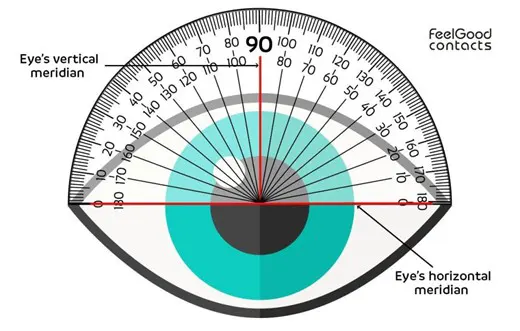
The axis on your prescription tells the optician where exactly to position the lens correction so that your vision is clear, which is measured in degrees from 1 to 180. If you see any number mentioned under the axis column in your prescription, it always means you have astigmatism, a very common eye condition where the front part of your eye (the cornea) isn’t perfectly round, but slightly oval-shaped. This shape causes light to bend unevenly, leading to blurred or distorted vision.
The axis indicates the direction where astigmatism is present. Think of it like giving precise instructions on a compass to your optician, who needs to know the exact angle where your cornea’s curve is uneven to be able to place the correcting power in the right spot of your contacts or glasses.
What is the normal eye axis?
There isn’t any one ‘normal’ axis number. If your eyes don’t have astigmatism, the axis column is left blank or has 0.0 mentioned. If you do have astigmatism, the axis can be any number between 1 and 180 that simply tells the direction of the uneven curve in your eye, like a compass point.
Is astigmatism on the 180 axis bad?
No, astigmatism on the 180 axis is not bad. It just means your astigmatism lies horizontally. Likewise, if it’s at 90, it lies vertically. Axis values only show direction and are unrelated to a person’s vision quality.
Is axis same as astigmatism?
No, axis and astigmatism aren’t the same thing. Astigmatism is the condition itself, caused by your eye’s uneven curvature. However, the axis is the measurement that shows in which direction an uneven curve exists. Think of it like this: if astigmatism is the problem, the axis is the map that tells your glasses or contact lenses exactly how to fix it.
Can the eye axis be corrected?
The axis is an essential part of astigmatic prescription and is needed to help correct astigmatism. It simply indicates the angle at which the cylinder should be positioned. There are a few ways this can be done:
- Glasses fitted with special lenses made with the cylinder power placed at the exact axis your prescription specifies.
- Toric lenses are designed specifically to correct astigmatism and are stabilised using special design features and rely on gravity to prevent rotation.
- Refractive surgery (like LASIK) to reshape the cornea and permanently correct astigmatism.
Understanding other major terms on your prescription
On your prescription, you’ll find many other symbols and terms as well. Let’s get familiar with two other major terms to help you read your prescription:
-
Sphere (SPH): SPH or ‘sphere’ in your prescription indicates the strength of the corrective lens required for your eyes, measured in dioptres. A minus sign before the number means you're nearsighted, making it hard to see objects at a distance. Conversely, a plus sign indicates farsightedness, causing nearby objects to appear blurry.
If your eyesight doesn't fit into either category, you may see an infinity symbol or ‘Plano’ in the sphere column. This means zero strength, suggesting no need for vision correction.
-
Cylinder (CYL): Your prescription will include a cylinder (CYL) number, typically in a '±' format. This represents the level of astigmatism, which can begin as small as ±0.25 for spectacle prescriptions. A blank box or DS indicates the absence of astigmatism, meaning your eyes are perfectly spherical.