Offers
 Account
 Menu
Menu Favorite
 Basket



 Need Optical Advice?












 Updated on:
08 May, 2026
Updated on:
08 May, 2026



 Copy Link



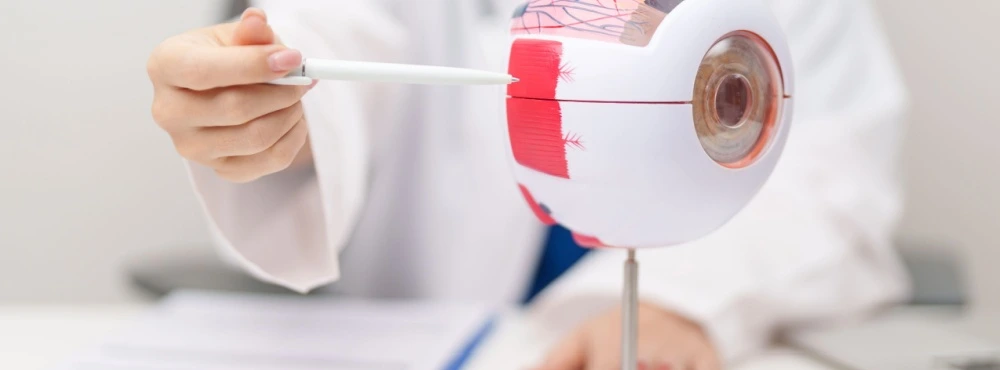
Refractive errors are the most common type of vision problems that affect people of all ages worldwide. They occur when the structural irregularities in the eye prevent light from focusing on the retina, the light-sensitive layer at the back of the eye. This leads to distorted or blurry vision.
In a healthy eye, light passes through the cornea and lens and focuses on the retina with precision. However, when the shape or structure of the eye is irregular, the visual process is interrupted as light is prevented from focussing directly on the retina, leading to refractive errors. Let’s understand the common types of refractive errors, why they occur and how they can be corrected in this article.
Types of refractive errors
There are four common types of refractive errors and they may occur in one or both eyes at the same time, affecting vision.
1. Myopia (Short-sightedness)
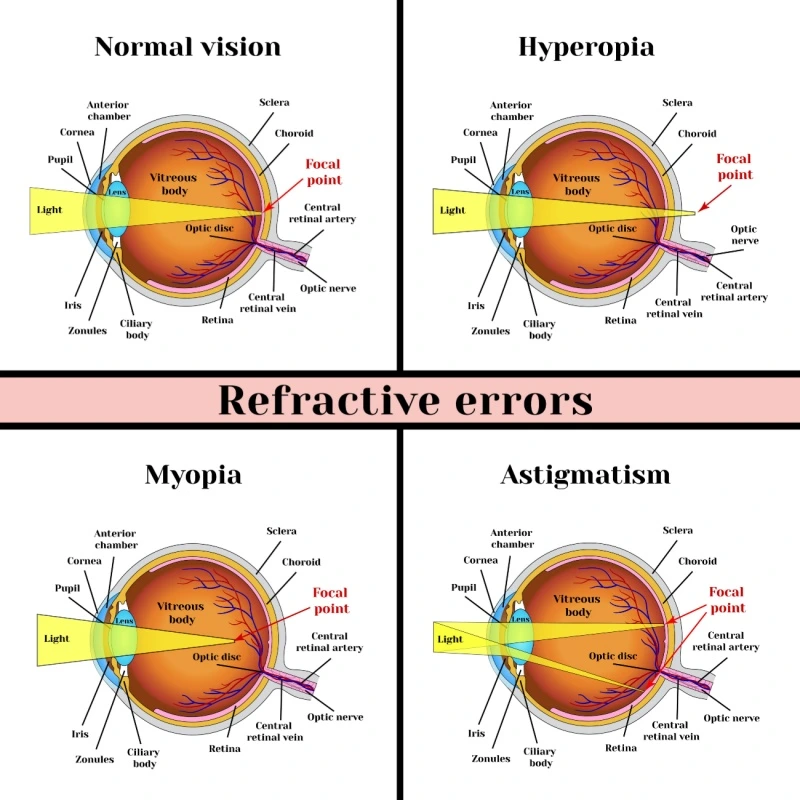
Myopia is when distant objects appear blurry while close objects remain clear. It typically occurs when the eyeball is too long or the cornea is excessively curved, causing light to focus in front of the retina.
2. Hyperopia (Long-sightedness)
Hyperopia is when nearby objects appear blurry while distant objects remain clear. It happens when the eyeball is too short, cornea is too flat or the eye cannot focus properly, causing light to focus behind the retina
3. Astigmatism
Astigmatism is a refractive error resulting from an irregular shape of the cornea or lens of the eye, causing light to focus unevenly. This leads to distorted or blurry vision at all distances.
4. Presbyopia
Presbyopia is an age-related condition that typically develops after the age of 40. It occurs when the lens of the eye loses its flexibility, making it difficult to focus on nearby objects.
What causes refractive errors?
To understand what causes refractive errors, one needs to examine the structure of the eye. However, common causes include:
- Irregular shape of the cornea
- Changes in the lens or its flexibility
- The eyeball is too long or too short
- Age-related changes in the eye structure
- Genetic predisposition
These structural variations alter how light bends inside the eye, preventing it from focusing on the retina as it should. Environmental factors and excessive screen time may also contribute to the progression of refractive errors, particularly myopia.
Symptoms of refractive errors
If you have a refractive error, you may experience the following symptoms:
- Blurred vision
- Eye strain or fatigue
- Headaches
- Squinting to see clearly
- Double vision in some cases
How are refractive errors diagnosed?
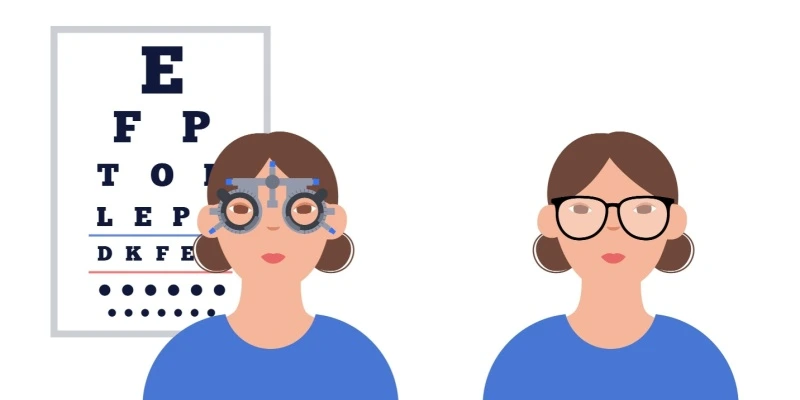
Refractive errors are diagnosed through a comprehensive eye examination conducted by an optometrist or ophthalmologist. It typically assesses visual acuity, refraction to determine prescription, eye health and eye structure. Regular eye tests are essential, even if you already use corrective lenses or prescription glasses, as your prescription can change over time.
Vision correction options
Refractive errors can worsen over time if not corrected. Some of the effective vision correction options include:
1. Contact lenses
Contact lenses are optical devices placed on the surface of the eye to correct refractive errors. They correct how light enters the eye so it focuses directly on the retina. For those who need vision correction at multiple distances, multifocal lenses are an ideal choice; whereas toric lenses are best for those with astigmatism. Available for different wearing schedules, such as daily, weekly, two weekly, monthly and extended wear, contact lenses offer clear vision to those with refractive errors.
2. Prescription glasses
Prescription glasses are the most widely used option to correct refractive errors. They are fitted with single-vision, bifocal or multifocal lenses as per the refractive error that is required to be corrected. To know which lens option is right for you, you can visit our guide or consult an optician.
3. Refractive surgery
Procedures such as LASIK or PRK reshape the cornea to correct the eye’s focusing ability, mostly resulting in 20-20 vision. They are typically recommended to individuals seeking a long-term solution.
You should always consult an optician to determine the best treatment option as per your lifestyle and vision needs.
Are refractive errors preventable?
Refractive errors are not entirely preventable, especially if they are caused by genetics or ageing. However, certain habits may support better eye health:
However, certain habits may support better eye health:
- Taking regular breaks from screens
- Maintaining a balanced diet
- Scheduling routine eye examinations
Refractive errors directly affect your vision and should not be ignored, even in their initial stage. Whether it is myopia, hyperopia, astigmatism or presbyopia, understanding the type of error is the first step towards effective management.
With prescription glasses and contact lenses, achieving clear vision is extremely easy. So, make regular eye check-ups (at least every 2 years) a part of your eye care regimen to ensure you have an updated prescription and your refractive error does not hamper your daily life.
Frequently Asked Questions
Are refractive errors permanent?
Refractive errors are not permanent, as vision can be effectively corrected with contact lenses or prescription glasses and in suitable cases, treated through refractive surgery. However, the structure of the eye usually remains the same.
Do refractive errors worsen with age?
Certain refractive errors can worsen over time. For example, myopia often progresses during childhood and adolescence, while presbyopia develops with ageing because the lens of the eye loses its flexibility. In adulthood, refractive stability is more common, but gradual changes may still occur.
Can screen time cause refractive errors?
Screen time does not directly cause refractive errors, but constantly focusing on digital screens can cause the development and progression of myopia, particularly in children. Additionally, excessive screen use can lead to digital eye strain.