Offers
When shopping for glasses and contact lenses online or in-store, an up-to-date copy of your prescription and an understanding of what the different values mean can help you make informed decisions about your new eyewear.
To get an up-to-date eye prescription, you will need to have an eye test and then your optometrist will provide you with a copy of your prescription with all the necessary details. Glasses and contact lens prescriptions contain different details, so it’s important to have the correct prescription for the type of vision correction you need. When booking your appointment, let your optometrist know whether you need glasses, contact lenses or both.
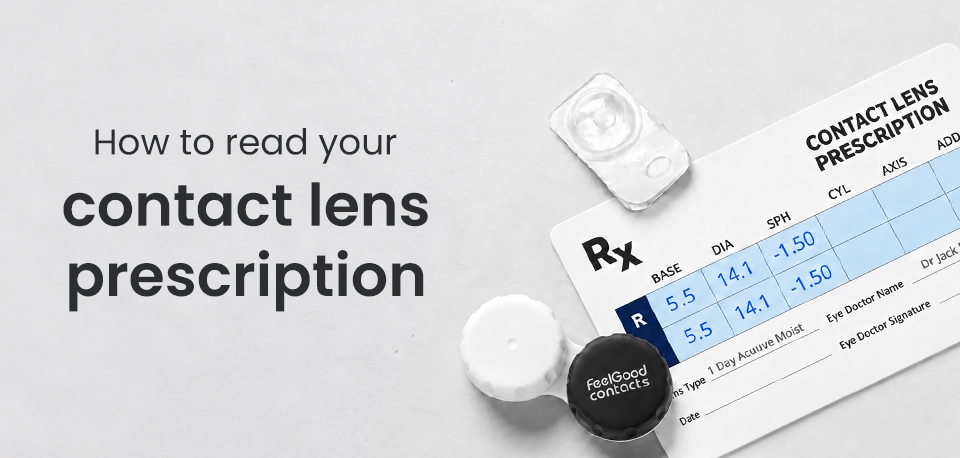
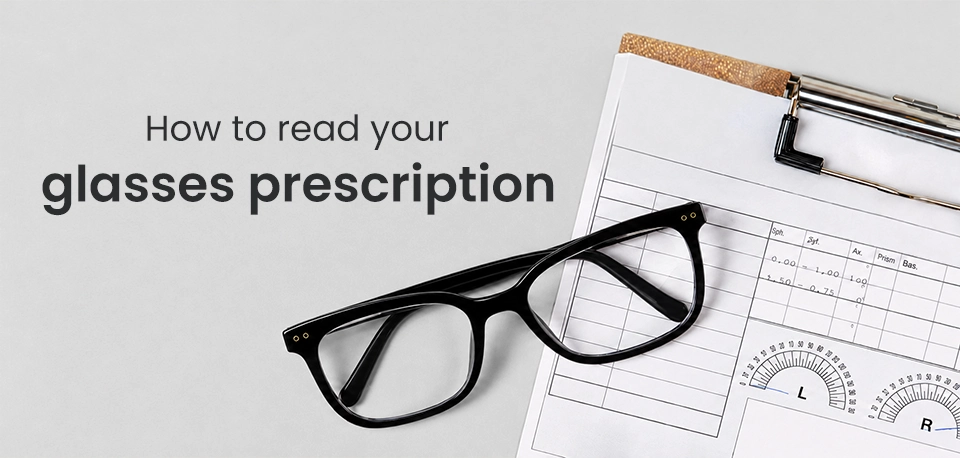
Here, we’ve explained prescriptions for both contact lenses and glasses in detail to help you understand them.
Your optometrist gives you a copy of your prescription after conducting your eye test.
On an eye prescription, R, RE or OD refers to your right eye, while L, LE or OS refers to your left eye. OD stands for oculus dexter (right eye) and OS stands for oculus sinister (left eye).
The axis value is always found on an astigmatism prescription. Because astigmatism is caused by an irregular curvature of the cornea or lens, the axis indicates the angle of correction needed for clear vision. It is measured in degrees from 1 to 180.
The cylinder value is also found on an astigmatism prescription along with the axis. It indicates the power needed to correct astigmatism. CYL can be written in a plus or minus form and increases in 0.25 steps.
PD stands for pupillary distance and can sometimes be found on a glasses prescription. It is the distance between the centre of one pupil and the centre of the other. PD is measured in millimetres (mm).
A plano on an eye prescription means zero power and no spherical correction is needed. It is usually written as PL or 0.00 on the prescription.
No, you cannot use your glasses prescription to buy contact lenses because glasses sit slightly farther from your eyes, while contact lenses sit directly on the cornea, so the vision correction values can differ. Contact lenses also require specific measurements to ensure a proper fit.
Neither a minus nor a plus eye prescription is worse. A minus prescription means short-sightedness (myopia), while a plus prescription means long-sightedness (hyperopia).
The lowest eye prescription is ±0.25, which may require glasses or contact lenses. However, whether you actually need to wear them depends on your symptoms and daily activities. An optometrist can advise you on whether vision correction would be beneficial.