Offers
 Account
 Menu
Menu Favorite
 Basket



 Need Optical Advice?










 Updated on:
18 June, 2026
Updated on:
18 June, 2026

 Copy Link


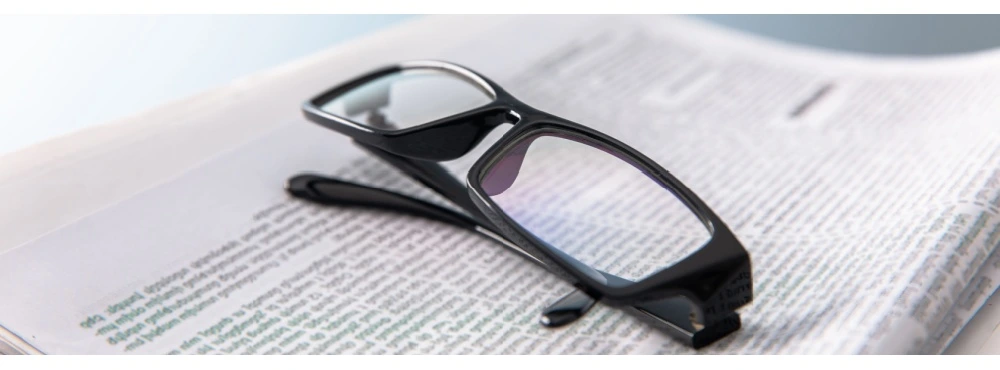
Reading glasses are essential for people with presbyopia, a common age-related eye condition that makes it difficult to see close-up objects clearly. These glasses provide clear near vision, making activities that require close-up vision, like reading, more enjoyable, effortless and free of eye strain.
There are two types of reading glasses available in the market: prescription reading glasses and ready readers, also called off-the-shelf readers or over-the-counter readers. You must choose the right type of reading glasses based on your visual needs and lifestyle. But, to do so, you must understand the difference between prescription reading glasses and off-the-shelf reading glasses. Read on to learn more about prescription reading glasses and over-the-counter readers.
- What is presbyopia and how is it caused?
- Prescription reading glasses vs over-the-counter readers
- Prescription reading glasses or ready readers: Which one is better?
What is presbyopia and how is it caused?
Presbyopia is a natural, age-related eye condition that causes nearby objects to appear blurry, while distant objects can still be seen clearly. This means that things like price tags, text messages, books or food menus appear blurry to such people, who are generally over 40 years old. As a result, they often must place the nearby objects at arm’s length to see them clearly.
Wut Win, a Dispensing Optician at Feel Good Contacts, explains, “Presbyopia occurs when the lens inside the eye hardens naturally and loses its flexibility, making it unable to change its shape and focus on close-up tasks, such as using a phone or reading a book.”
Presbyopia isn’t a disease, but it can occur alongside other age-related eye conditions, such as glaucoma and cataracts. Presbyopia can be corrected with contact lenses, prescription glasses, refractive surgery, and corneal inlays.
Prescription reading glasses vs over-the-counter readers
Regular ready readers come in standard magnification strengths (usually from +1.00 to +4.00) with the same lens power for both eyes. They can be used by people with mild presbyopia who occasionally need reading glasses. However, they may cause discomfort or eye strain if worn for prolonged periods, particularly if the person has presbyopia along with other refractive errors, or if both eyes have different prescriptions.
On the other hand, prescription reading glasses help you correct presbyopia, along with other refractive errors, such as hyperopia (farsightedness), myopia (nearsightedness or shortsightedness) or astigmatism (blurred vision due to an irregularly shaped cornea). An eye exam conducted by a qualified ophthalmologist or optometrist can tell you about your specific vision requirements. Based on this, your prescription reading glasses are customised to correct your vision.
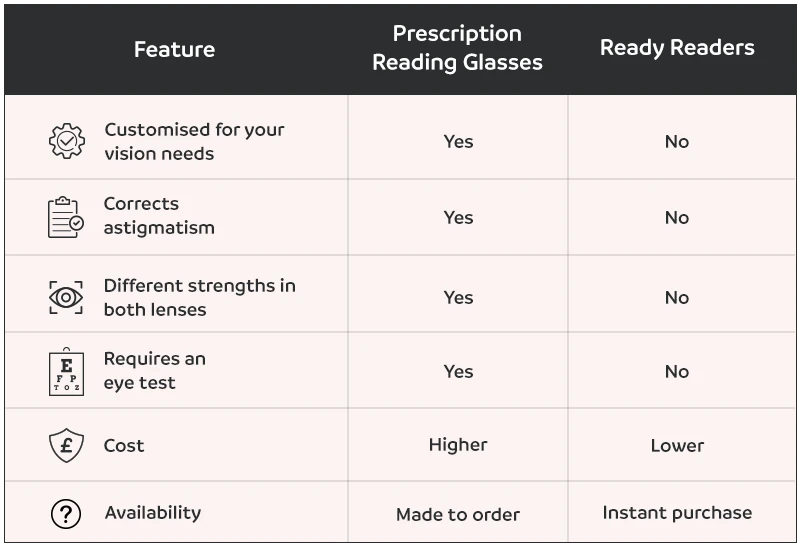
Below are some of the major differences between prescription reading glasses and off-the-shelf glasses for reading:
1. Customisation
Prescription reading glasses are made as per your unique optical requirements, as listed on your prescription. These include any refractive errors you have and the magnification required for reading for each eye, which is shown on your glasses prescription in the form of SPH (sphere), CYL (cylinder), axis, ADD (addition), OD (Oculus Dexter, meaning right eye) and OS (Oculus Sinister, meaning left eye).
On the other hand, over-the-counter readers are mass-produced, with a standard prescription for everyone. They have some corrective power. However, they don’t correct any other vision problems you may have and they have the same power for both eyes. They are not made with your specific PD (pupillary distance) measurement. Moreover, you don’t need a prescription or eye test to buy these eyeglasses. You can simply buy them at most supermarkets, pharmacies or online.
2. Lens quality
Prescription reading glasses feature high-quality lenses that not only provide clear vision but are also made from durable and lightweight materials. You can also add different types of lens coatings, such as hydrophobic and anti-scratch coatings, based on your lifestyle and preferences. Additionally, they undergo rigorous quality checks to ensure they are free of defects. On the contrary, ready readers are fitted with standard lenses and don’t undergo the same level of quality checks and they don’t come with any specific lens coatings.
3. Cost
When it comes to prices, over-the-counter readers cost less compared to prescription spectacles. However, prescription reading glasses offer better value in the long run, as they are customised according to your optical prescription and feature high-quality lenses.
4. Vision Correction
Prescription reading glasses help correct different vision issues, including hyperopia, myopia and astigmatism, along with presbyopia. They are made after an eye test to determine the power each eye needs, with your individual prescription in mind. On the other hand, off-the-shelf glasses simply magnify close-up objects, such as the fine print, but don’t correct any vision issues.
Prescription reading glasses or ready readers: Which one is better?
Prescription readers are better than over-the-counter readers for so many reasons. This includes higher-quality lenses, different lens coatings and customised lenses that help correct vision problems. They also help alleviate eye strain, provide visual comfort and maintain long-term eye health.
Thus, if you need vision correction, have different powers in each eye or need to wear eyeglasses daily, then go for prescription glasses. However, if you have a simple near-vision prescription that is similar in both eyes and you only need glasses occasionally for a quick close-up vision, such as checking a menu, then over-the-counter glasses are a cost-effective and convenient option for you.